


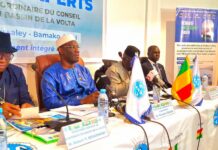
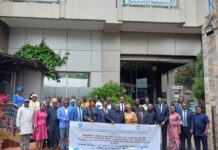
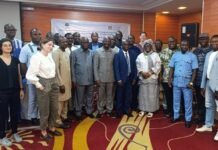
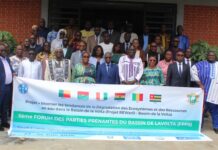
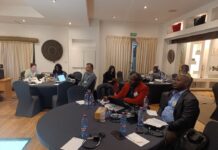


On Friday, 18 July 2025, in Natitingou, Benin, a national workshop organised by the Volta Basin Authority (VBA) in collaboration with the Global Water Partnership in Africa was held under the chairmanship of Ms Déré Lydie CHABI NAH, Prefect of ATAKORA, a national workshop organised by the Volta Basin Authority (VBA) in collaboration with the Global Water Partnership in West Africa (GWP-WA) and VBA National Focal Point (NFP) of Benin.
This national workshop brought together around fifty participants, including representatives of organisations of users of natural resources in the Volta Basin, territorial and customary authorities from the national portion of the Volta Basin in Benin, experts from the regional directorates of the VBA NFP member sectors (energy and mines, agriculture, livestock, Environment, Fisheries, Territorial Administration, etc.) and executives from the ABV and GWP-WA. The aim was to establish the National Coordination of Users of Natural Resources in the Volta Basin in Benin.
In her opening speech, Ms. CHABI NAH, Prefect of Atakora, emphasised the importance of this meeting. She stated: ‘This meeting for consultation and exchange between the ABV, central and decentralised authorities, technical services and users of our water resources in the Volta Basin strengthens the participatory governance of resources in our national portions of the basin.’
 She also expressed her gratitude to VBA and GWP-WA for this initiative and praised the relevance and qualitative changes brought about by the project. Finally, she extended her sincere thanks to the Global Environment Facility (GEF), the United Nations Environment Programme (UNEP) and the International Union for Conservation of Nature (IUCN).
Dr Rafatou FOFANA, Director of the Volta Basin Observatory, representing the Executive Director of VBA, emphasised the importance of this project, which will help reverse the trends of ecosystem and water degradation to support integrated ecosystem-based development in the Volta River Basin through strengthened transboundary governance, ecosystem restoration and conservation for sustainable livelihoods. She also presented the four components, the second of which focuses on strengthening regional and national cross-border planning and coordination capacities.
As a reminder, the national workshop was held as part of the implementation of activities under the project ‘Reversing Ecosystem and Water Degradation Trends in the Volta Basin’ or REWarD – Volta River Basin, funded by the GEF through UNEP and IUCN.
Among other things, it enabled the validation of pre-selected organisations, the adoption of the constitutive texts, the capacity-building plan and the initial work plan, as well as the election of the Executive Bureau of the National Coordination of Users, which is composed of fifteen (15) members, including five (05) women. It also served as a framework for laying the groundwork for official recognition by the administrative authorities.

Mr. Parfait Midama N’SERA, President of the Executive Board, reassured participants of his commitment to work with all members of his Board. He stated, ‘Together, we will work to fulfil the expectations of the Coordination so that at the end of our three-year term in 2028, our team will have made its mark in the history of the basin.’

Following Mali and Benin, the establishment of National Coordination Committees for Users of Natural Resources in the Volta Basin in Benin is continuing, with Côte d’Ivoire and Burkina Faso as the next steps. The responsibilities of these Coordination Committees revolve around eight main functions:
1. Consultation: organising regular dialogue between users at national and regional level.
2. Institutional participation: representing civil society in VBA’s statutory bodies.
3. Mobilisation of users: ensuring active participation in decision-making and public consultation processes.
4. Support for public policies: contributing to public water and environmental management plans and projects.
5. Promotion of good practices: encouraging sustainable solutions and preventing conflicts over water use.
6. Communication: develop and implement a communication plan for communities in the basin.
7. Capacity building: train users in integrated water resource management (IWRM).
8. Advisory assistance: support authorities and organisations in the sustainable management of natural resources.
